Miss Clark's Spoonful: Daily 5
Showing posts with label Daily 5. Show all posts

My Top 2 Reading and Language Arts Books Every Teacher Should Read


Balanced Literacy?

Readers Workshop?

Guided Reading?

If you're anything like me, you feel like you've done it all.

Teaching reading is one of the most critical responsibilities teachers have. After all, it lays the foundation for all other learning - opening up a world of knowledge and possibilities for our kids (No pressure!). With the huge variety of approaches and methodologies available, finding the best ways to teach reading can be overwhelming.

Never fear! Integrating research-based strategies can make the complex task of reading instruction more effective and successful.

It's been so much fun sharing my top reads that stretch across the curriculum. Keep reading for books that will transform your literacy instruction!

READING AND LANGUAGE ARTS: MY TOP 2 READS


1. The CAFE Book (Expanded 2nd Edition) by Gail Boushey and Allison Behne

Cover of The CAFE Book (Expanded 2nd Edition)

Once upon a time, I lived and breathed everything about CAFE & Daily 5 when it came to literacy instruction. The CAFE framework (Comprehension, Accuracy, Fluency, and Expanding Vocabulary) was THE system when it came to helping students set personalized goals and provide targeted instruction.

Don't get me wrong, it still is. Now, it's improved. Why? The Accuracy instruction better embraces the importance of phonics instruction and the Science of Reading. Instead of "Check the Picture," strategies like, "Map it," and "Look Carefully at Letters and Words" are being implemented. Hooray!!!

This book is one that you're going to want to get your highlighters and sticky notes out for (and I think you'll love it!).

The expanded second edition enriches the original CAFE framework with updated research, new strategies, and enhanced tools to better support teachers and students.

Why The CAFE Book is Essential for Teachers

You are taken through setting up "The CAFE menu," a visual tool that outlines the four key literacy goals: Comprehension, Accuracy, Fluency, and Expanding Vocabulary. Step-by-step, you'll also learn how to conduct individual conferences, create strategy groups, and track student progress. All of this with updated research and insights!

1. Personalized Learning: The CAFE framework emphasizes individualized instruction. It supports teachers in tailoring instruction to meet the specific needs of each student! This personalized approach is crucial for addressing diverse learning styles and abilities within the classroom.

2. Student Engagement: One of the core principles of The CAFE Book is engaging students in their own learning process. We all know that when students are involved in goal setting and self-assessment, it makes it a lot easier for you to foster motivation!

3. User-Friendly Tools: The book provides a ton of practical tools, including updated assessment forms, checklists, and record-keeping templates. These tools simplify the process of tracking student progress and planning instruction.

4. Support for Diverse Learners: Recognizing the diversity in student abilities and learning styles, the CAFE framework offers strategies for differentiating instruction. This ensures that all students, regardless of their starting point, receive the support they need to grow as readers.
0

How to Structure Your Perfect Literacy Block!

As far as I'm concerned, there is no "right" way to structure a literacy block. Literacy Centers, Guided Reading, Daily 5... there are so many resources and formats to choose from! Depending on how your schedule works, it can be super tricky to fit it all in. Sometimes, I find that it works best to take a little bit from each style and make your literacy block your own.

95% of our literacy block structure is from The Daily 5. I learned how to teach a balanced literacy block this way as a student teacher, and I immediately fell in love.

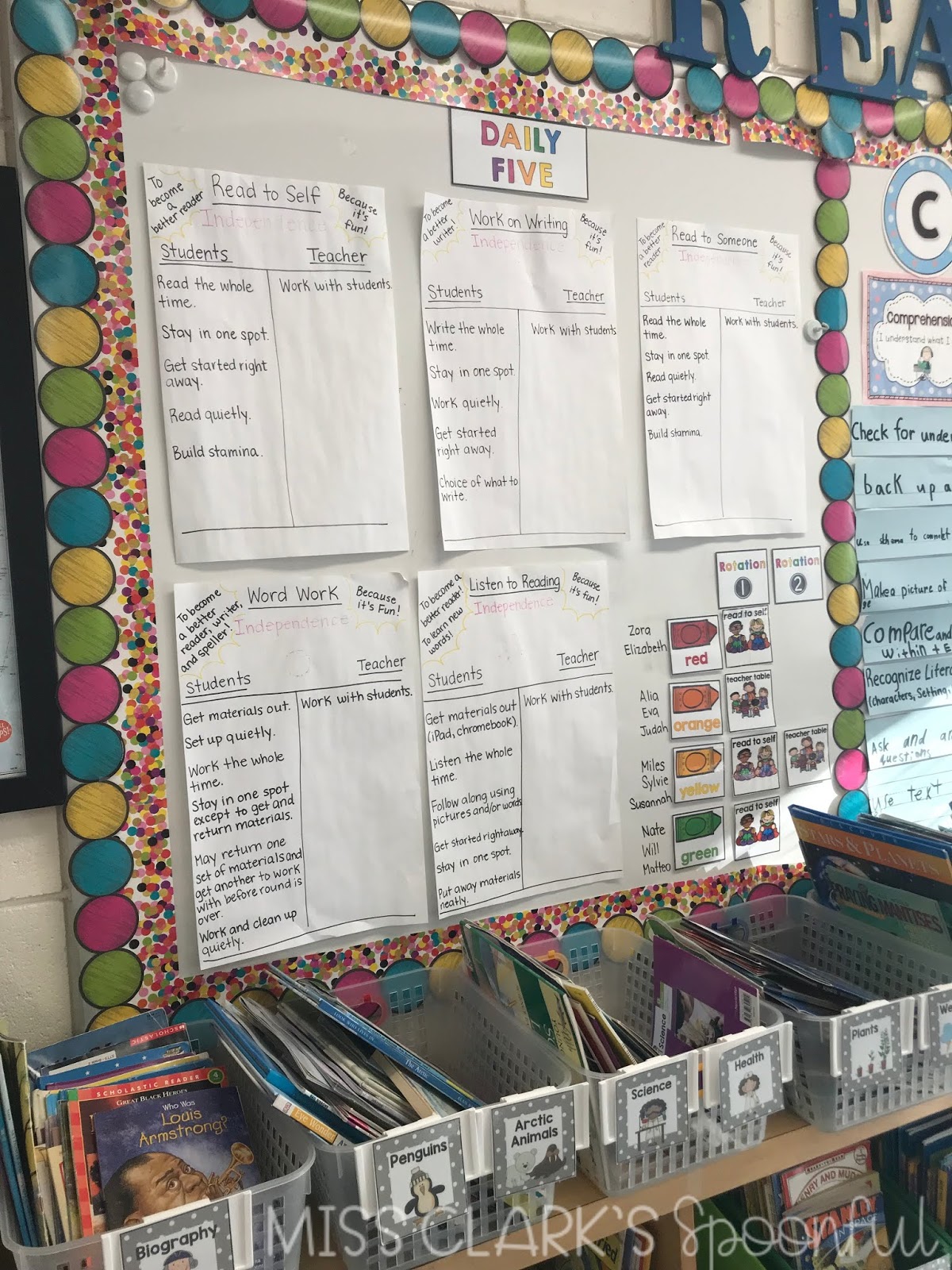
Here is what our Daily 5 Board looks like in our classroom! It's right beside the CAFE Board, which displays our reading strategies. True life, people... it's February and the bulletin board border isn't as pristinely staying in place as it was back in September.

daily five icharts

You'll notice that at the bottom right corner of the Daily 5 Board, our rotations are listed. The stations the children visit each week are: Teacher Table, Read to Self, Work on Writing, Read to Someone, Word Work, and Listen to Reading.

Now, for the tricky part. My kids have either two or three specials each day. While it makes for incredibly rich learning, it's hard to structure a consistent block of time dedicated to literacy.

Here's how we make our daily rotations work!

Rotation 1:

10:30 am - 10:40 am: Whole group mini-lesson - The mini-lesson varies! Our school uses Reading Wonders as a resource, so sometimes the mini-lesson will be a comprehension skill/strategy from Wonders. Other times, it will be based on a specific unit (right now, we're in the middle of biographies), or an interactive read aloud involving turn & talks and think alouds. In the beginning of the week, we'll usually cover a phonics skill.

10:40 - 11:00/11:15: Read to Self and Reading Group - I am lucky enough to have an assistant teacher with me all morning. She is THE BEST. In the morning, she will take a reading group while I hold individual conferences with the other students as they Read to Self. While conferencing with the children during Read to Self, I take anecdotal notes on these conferencing sheets. Usually, I'll conference with 3 or 4 children per day.

The work that the children do in reading group varies. Sometimes they'll read a story and answer comprehension questions from the Wonders workbook, or anthology. I'm not a huge fan of strictly teaching whole group from comprehensive literacy programs, and in a small group setting, it's more meaningful. It's also a way to make sure that everyone covers important comprehension skills that week while catering to that group's individual learning styles!

miss clark's spoonful reading wonders grade 2 vocabulary minibook
If they're not working out of the workbook, they may be working on the week's phonics or vocabulary skill.

Part of what I like about Wonders is the scope and sequence of vocabulary strategies. The kids enjoy making these mini-books in reading group! You can find them in my TpT shop here!


At 11:00 (or 11:15, depending on the day), the kids are off to specials. Then, we have lunch from 12:30 - 1:00, and afternoon recess from 1:00 - 1:30. On Tuesdays, Thursdays, and Fridays, the kids have another special from 1:30 - 2:00. Mondays and Wednesdays, we're back in the classroom at 1:30. Whether it is 1:30 or 2:00, this is when we resume the literacy block!

Rotation 2:

1:30 pm - 1:40 pm/2:00 pm - 2:10 pm: Whole group mini-lesson - Again, the mini-lesson will vary! In the afternoon, I usually like to keep things reading comprehension strategy focused and pair the mini-lesson with an interactive read aloud.

1:40 pm - 2:20 pm/2:10 pm - 2:30 pm: CHOICE! While I am meeting with one group at the Teacher Table, the other students choose to visit either Read to Someone, Work on Writing, Word Work, or Listen to Reading. Of course, all of these stations were slooooooowly introduced, modeled, and practiced in the beginning of the year before everything was up and running independently.

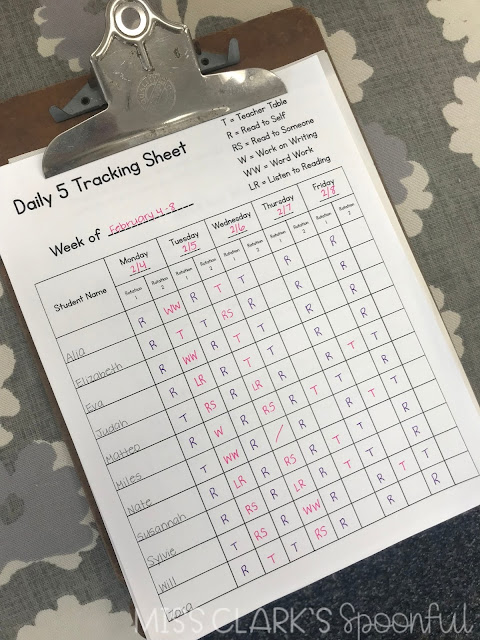
I keep track of who goes where with this tracking sheet! The students are allowed to visit the same station more than once during the week, as long as it's not two days in a row.

daily five tracking sheet

The students also keep track of their own progress. This darling freebie was from Martha over at Primary Paradise on TpT! On the first day of the week, the kids each get a blank rainbow tracking sheet. Each time they visit a station, they color in the corresponding place on the rainbow!

I've found that this tool inspired students to branch out and do less repeating of stations. They're SUPER motivated to fill in all five colors.

daily five check in sheet

Throughout the week, the kids keep all of their work from Daily 5 in a folder. At the end of the week, I'll collect the work from each student's Daily 5 folder, and staple it all together with the tracking sheet on the front. I usually won't meet with a reading group for Rotation 2 on Friday afternoons. Everyone has a choice of their Daily 5 station.

This is when I'll collect each student's work from the week and put it together. As students are working in their choice station, I'll call them over to go over their work from the week. We celebrate new stations that were visited, progress on a certain skill, and correct work when needed. After this brief conference, they color in the last place on the rainbow, the teacher check. Everything gets sent home at the end of the week. It's nice for parents to see exactly what their kiddos have done throughout the week during Daily 5!

Well, that's what a week of Daily 5 in our classroom looks like (in a nutshell).

For my fellow Daily 5 friends, I uploaded my Daily 5 Tracking Sheet to TpT, for FREE! You can download it here or by clicking the picture below.

miss clark's spoonful free daily five tracking sheet

0